

Equipment failure during welding is rarely sudden. MIG welding cables show signs of wear long before they stop working entirely. Catching those signs early prevents unplanned downtime. It also protects operators and production equipment. A degraded cable affects arc quality and creates safety hazards. It can also lead to costly rework and rejected parts.
Understanding the warning signs helps procurement managers and production teams make timely replacement decisions. This guide covers what to look for before a cable reaches the point of failure.
Visible Damage to the Outer Jacket
The outer jacket is the primary layer of protection for welding cable. It shields the conductor assembly from abrasion, chemicals, and heat exposure. Cracks, cuts, and gouges in the jacket should be treated as immediate warning signs. Even minor surface damage can grow under repeated flex cycles. Exposed conductors create a real risk of arcing or short circuits.
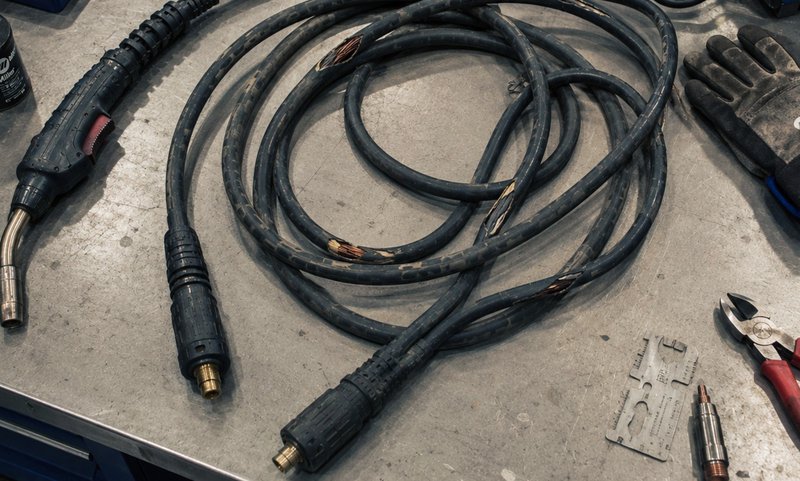
Discoloration is another indicator worth watching. A jacket that has turned brown, brittle, or shiny has experienced thermal stress. Sections near the torch head typically take the most heat and mechanical wear. Any visible compromise to jacket integrity warrants a close inspection and likely replacement.
Arc Instability and Inconsistent Weld Quality
Weld quality is often the first measurable sign of cable degradation. A cable with internal damage introduces resistance into the circuit. That resistance disrupts current flow and causes arc instability. Increased spatter without any change in settings is a common early symptom.
Weld porosity or inconsistent bead appearance may also point to a cable issue. Voltage drops during active welding indicate that the conductor is no longer carrying current efficiently. Broken or compressed strands inside the cable reduce its overall current-carrying capacity. If performance issues appear and equipment settings check out, the cable itself should be the next thing inspected.
Heat Damage and Overheating Symptoms
A cable that runs hotter than normal is under stress. Heat buildup accelerates jacket degradation and conductor fatigue. It also signals that the cable may be undersized for the application. Checking for heat-related damage should be part of regular equipment maintenance.
Watch for these specific signs:
- The cable feels hot to the touch during or after normal welding cycles
- Jacket sections show bubbling, softening, or a shiny, melted texture
- A persistent burning smell lingers after the weld area cools
- The cable develops stiff sections that were previously flexible
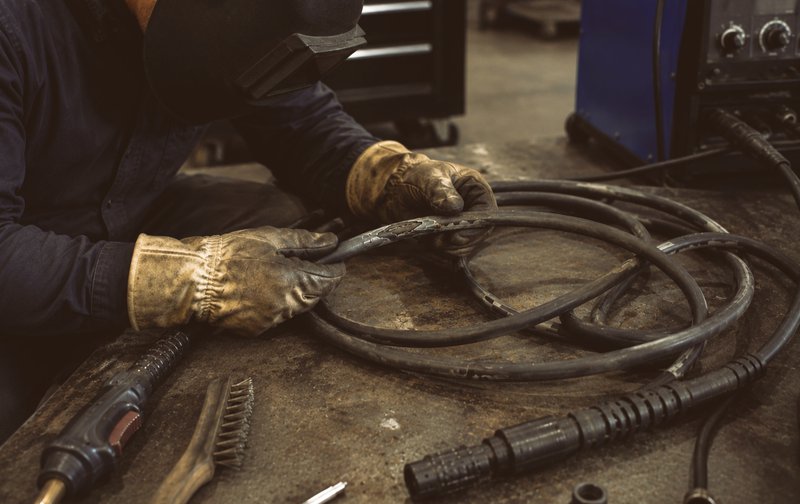
Conductor construction plays a direct role in heat performance. Fine-strand copper conductors distribute current more evenly. They also manage heat more effectively under load. Cables rated for higher amperage reduce thermal stress during extended production runs.
Physical Wear at Connectors and Along the Cable Body
The most mechanical stress on a welding cable occurs at the connection points. Ferrules and connector ends experience constant pulling, twisting, and bending during use. Over time, this stress causes conductor strands to break at the connection site. A cable that sparks at the connector end signals internal damage at that junction.
Kinks along the cable body are another warning sign. A kinked cable places concentrated stress on individual strands. Once strands begin to break, the problem compounds with each use cycle. Stiffness that develops in a previously flexible cable usually means internal damage has already occurred. Replace the cable before that stiffness results in a full conductor break.
MIG Welding: Build the Right Cable for Your Operation
You shouldn’t have to work around a cable that’s letting your operation down. At Electron Beam Technologies, we manufacture custom MIG welding cables built for demanding industrial environments. We draw our own copper and mix our own XLPE jacket compounds. Our electron beam curing process creates a stronger molecular bond in the jacket.
That means better resistance to heat, abrasion, and chemicals over the life of the cable. Every cable is built to your exact specifications. Our domestic manufacturing ensures short lead times without the uncertainty of international shipping. You also avoid the added costs that come with tariffs on imported products.
If your current cable is showing signs of wear, contact us today. Let’s build you a custom replacement that performs reliably from day one.
You must be logged in to post a comment.