

When a customer orders custom wire or cable, they are trusting a manufacturer. Customers trust the delivery of a product that performs exactly as specified, on time, every time. Behind that promise sits a decision most buyers never see: how much of the production process the manufacturer actually controls. That decision is called vertical integration. More importantly, it has a direct impact on both the quality of the finished cable and the reliability of the supply chain behind it.
What Vertical Integration Actually Means
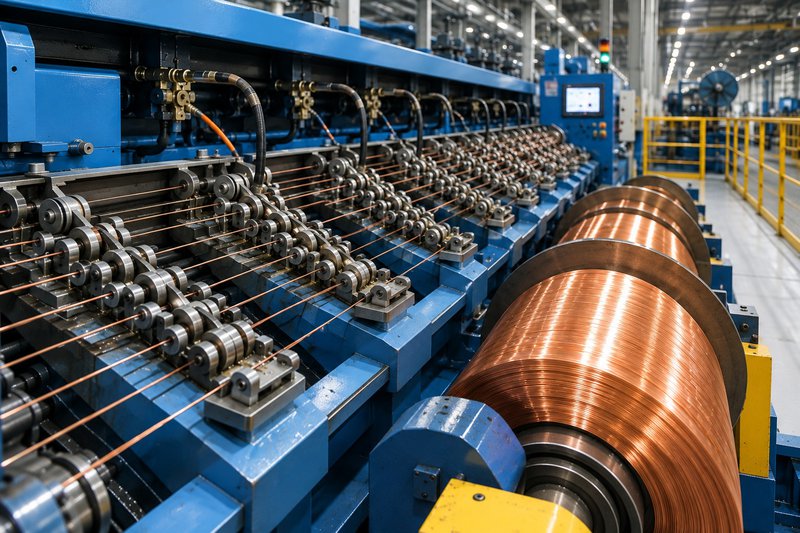
Vertical integration means a company manages multiple production stages instead of outsourcing them to third parties. In custom wire and cable manufacturing, this includes drawing copper from a raw rod and formulating jacket compounds. It also includes extruding and curing insulation and performing final testing, all under one roof.
Contrast this with a non-integrated competitor. That supplier might purchase pre-drawn copper from another supplier. Then they’ll source the compound from another. That competitor might even outsource curing to a separate facility. Each additional vendor introduces a new variable, a new lead time, and a new opportunity for something to go wrong. Vertical integration removes many of those variables by keeping control close to home.
How This Setup Improves Cable Quality
Quality control is easiest to enforce when a company owns every step of the process. Consider what happens when copper is drawn in-house rather than purchased from an outside mill. Engineers can specify exact conductivity, temper, and diameter tolerances. They can also verify them immediately, instead of relying on a supplier's certification and hoping it matches every batch.
The same principle applies to compound mixing. Manufacturers that formulate their own jacket compounds can tailor materials for specific applications. They can improve cold-weather flexibility, abrasion resistance, or chemical resistance for harsh industrial environments. Off-the-shelf compounds usually satisfy general use. However, custom-mixed compounds fit unique requirements.
Curing is another area where vertical integration pays off. Electron beam crosslinking strengthens the cable jacket at the molecular level and occurs entirely in-house. It produces a tougher, more durable product than compounds cured with conventional heat methods. Because compounding, extrusion, and curing happen together, engineers can adjust formulations and curing parameters simultaneously. They avoid shipping products to third parties and waiting for test results.
Strengthening Supply Chain Reliability
Quality is only half of the equation. The other half is dependability, and vertical integration plays just as significant a role there. Every outside vendor in a supply chain is a potential point of failure. A shortage at a copper mill, a delay at a compounding facility, or a backlog at a curing subcontractor can all stall a project that has nothing to do with the manufacturer's own operations.
By drawing copper and mixing compounds internally, a vertically integrated manufacturer removes several of those failure points entirely. Lead times become more predictable because they depend on internal scheduling instead of multiple external suppliers. External suppliers each have their own backlogs and production priorities. Integrated manufacturers also have greater flexibility when raw material costs rise or copper supplies tighten. They can manage more of the impact instead of passing every cost increase to customers.
This kind of resilience matters more than ever. According to the National Institute of Standards and Technology, much of a manufacturer's spending occurs within its supply chain. That makes the supply chain a key target for cost reduction and risk mitigation. Bringing production stages in-house shortens the supply chain and reduces uncertainty. It also reduces reliance on multiple outside vendors.

Vertical Integration and Custom Wire and Cable Production
Custom orders put vertical integration to the test. A customer with a unique application, whether that involves unusual voltage requirements, extreme temperature ranges, or tight space constraints, needs a manufacturer that can adjust multiple parts of the process at once. A vertically integrated operation can modify copper temper, compound formulation, and jacket thickness in a coordinated way, rather than negotiating changes across several outside suppliers who each have their own constraints.
This flexibility helps engineers shorten custom cable development time and reduce the number of prototype rounds before they finalize a design. It also means that when a customer needs a modification mid-project, the manufacturer can respond quickly instead of waiting on a third party's production schedule.
Why This Matters When Choosing a Cable Supplier
For buyers evaluating wire and cable suppliers, asking about vertical integration is one of the most useful questions they can raise. A manufacturer that draws its own copper, mixes its own compounds, and cures its own jackets is in a better position. They can guarantee consistent quality and hold firm on delivery timelines, even when market conditions get difficult. Vertical integration is not simply a manufacturing philosophy. It is a practical advantage that shows up in every cable that ships and every deadline that gets met.
If you are evaluating suppliers for an upcoming project or need a custom wire or cable solution built to your exact specifications, don’t hesitate to send us a message. We would welcome the chance to walk through your requirements and show you what a vertically integrated process can do for your next order.
You must be logged in to post a comment.