

MIG welding performance depends on more than technique and machine settings. The welding leads connecting your machine to the torch have a direct impact on arc performance, heat management, and operator efficiency.
Coaxial MIG cable offers a fundamentally different design compared to conventional two-lead setups. It addresses several performance limitations that separate cable assemblies cannot. For procurement managers and engineering teams, understanding this difference translates into better cable specifications and fewer operational problems.
How Coaxial MIG Cable Is Constructed
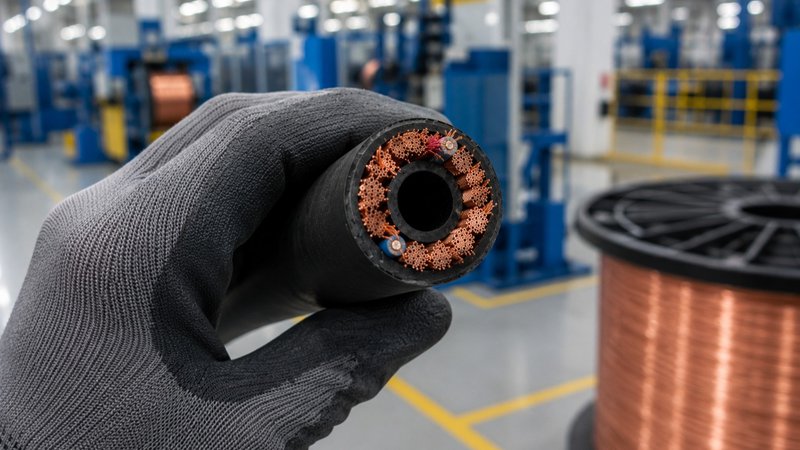
Coaxial MIG cable is built around a concentric design. At the center of the cable is a hollow tube. This tube carries the inert shielding gas and guides the welding wire on its path to the torch. There is no return current path inside this tube.
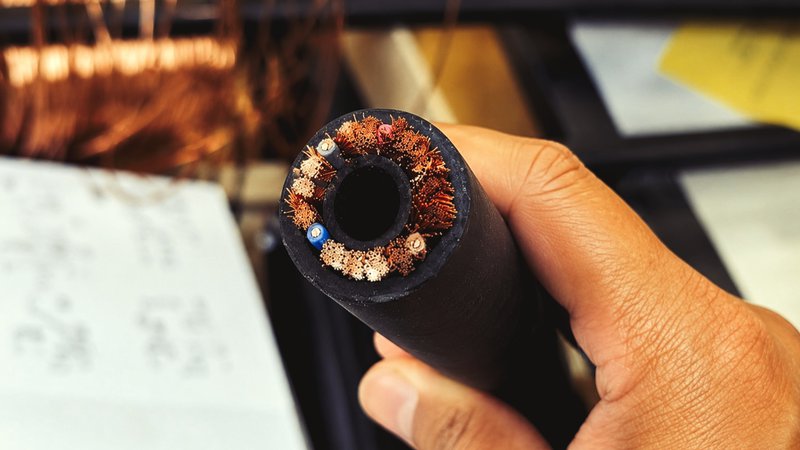
Surrounding that central tube is the copper conductor stranding. This conductor carries the welding current from the machine to the torch. A protective jacket covers the entire assembly.
This layout bundles three functions into one cable. Gas delivery, wire feed, and current flow all travel together. That is the coaxial part of the design. Everything runs concentrically around a shared centerline instead of as separate hoses and cables.
Additional layers refine the cable’s performance. These components typically include:
- A shielding layer beneath the outer jacket to reduce electrical interference
- Fillers that maintain the cable’s round cross-section under repeated flexing
- Separators between layers to prevent conductor contact and preserve cable geometry
Bare copper stranding is also critical to flexibility. Finer strand diameters produce a more supple cable. This suits applications where the welder needs maximum range of motion. Heavier-gauge strands add stiffness, which works well for fixed or semi-fixed installations.
Why Traditional Welding Leads Fall Short
Every arc welding process needs a complete circuit. That means a lead to the torch or electrode and a separate work return cable back to the machine. This is true for stick, TIG, and MIG welding alike. Coaxial design does not change that requirement.
Where MIG setups differ is in how the torch-side components are managed. In a non-coaxial MIG setup, the gas hose, the wire liner, and the power conductor run as separate parts. They get taped, clipped, or bundled together by hand.
This creates practical problems. Loose components tangle easily on active shop floors. They create trip hazards and slow down welder movement. Cable management takes time away from production.
Wire feed also suffers. A gas hose and power cable that shift independently can pull or kink the wire liner. Tight bends increase friction between the liner and the wire. That friction leads to poor feeding, wire shaving, and more frequent liner replacement.
Stick welding avoids some of these problems since it has no gas hose or wire liner to manage. TIG welding uses a separate torch lead and gas line, too. That setup is usually lighter than a full MIG gun cable. MIG welding has the most components to coordinate at the torch. That makes bundled cable design especially valuable for MIG applications.
Welding Leads: Performance Advantages of the Coaxial Design
Coaxial construction keeps the gas hose, wire liner, and power conductor in a fixed, protected position relative to each other. This reduces the friction and kinking that loose components create.
Consistent wire feed depends on a straight, unobstructed path through the liner. When the liner is bundled inside a coaxial cable, it holds its shape better. Wire feeds more smoothly. Arc starts stay consistent, and burnback problems decrease.
The single-cable format simplifies the workspace. Welders move more freely without managing separate hoses and cables. Setup is faster. There is also only one cable assembly to inspect and replace, which reduces maintenance time in high-volume production environments.
Compared to stick welding, coaxial MIG cable adds a level of bundled convenience. Stick leads stay simpler, but they require constant electrode changes. TIG often separates the gas line from the torch lead. Coaxial MIG cable keeps the whole system in one jacket instead. This matters more as duty cycles and cable lengths increase.
Jacket Materials That Determine Real-World Welding Leads Performance
The outer jacket is the cable’s primary defense against its working environment. Material selection determines how the cable holds up against abrasion, heat, chemicals, and continuous bending. Not all jacket materials perform equally under demanding conditions.
When specifying jacket material, evaluate these properties:
- Abrasion resistance for cables dragged across rough surfaces or metal debris
- Flexibility ratings for overhead welding or confined-space applications
- Sustained temperature resistance for high-duty-cycle operations
- Chemical resistance where the cable contacts oils, solvents, or cleaning agents
XLPE (cross-linked polyethylene) delivers strong performance across each of these categories. Cross-linking alters the polymer structure at a molecular level. This makes the material more resistant to heat, abrasion, and chemical exposure. XLPE also maintains flexibility without sacrificing toughness. Standard polyethylene cannot match these properties because it lacks the cross-linked structure.
Ready to Specify a Cable Built for Your Operation?
At Electron Beam Technologies, we manufacture custom coaxial MIG cable from the ground up. We draw our own copper and mix our own XLPE compounds in-house. That level of vertical integration gives us precise control over every layer of your cable.
Our electron beam curing process cross-links jacket compounds, strengthening the material from within. This delivers greater durability than conventional chemical curing methods can achieve.
You bring the application requirements. We build the cable to match them. Our U.S.-based manufacturing keeps lead times short and removes the unpredictability of international shipping. If tariffs or supply chain delays are affecting your current sourcing, we can help.
Reach out to our team to start your custom cable specification.
You must be logged in to post a comment.