
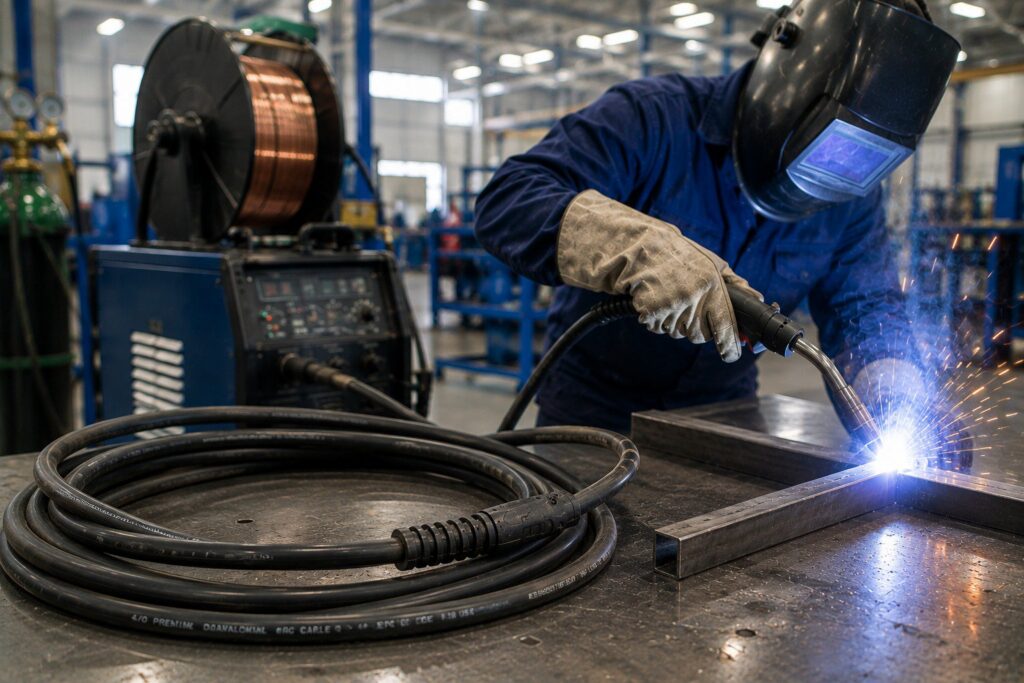
Welding relies on two cables that look alike but do opposite jobs. One carries current, gas, and wire feed toward the weld pool. The other returns that current to the power source. These are the MIG cable and the grounding cable. Purchasing teams and OEMs often treat them as interchangeable. They are not. Knowing what separates them helps you spec the right part for each role. That one decision protects weld quality, operator safety, and uptime.
What a MIG Cable Delivers
A MIG cable is the working end of the welding circuit. It does far more than carry electricity. The MIG cable bundles several jobs into one flexible assembly. That bundle runs from the wire feeder to the welding gun.
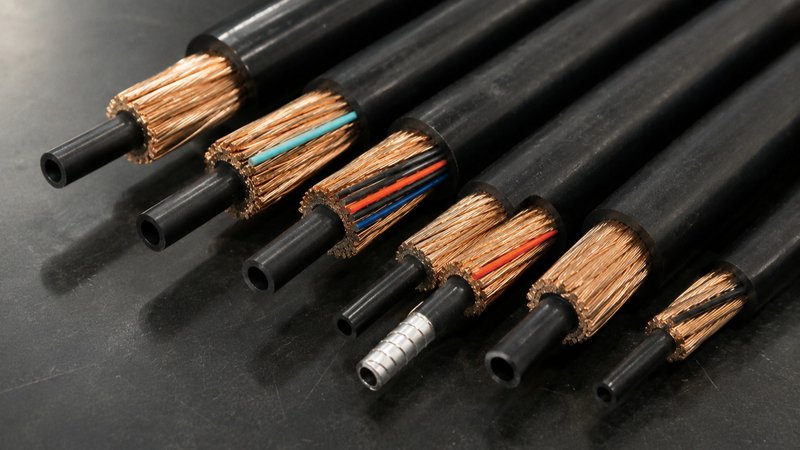
A well-built MIG cable typically carries:
- Welding current: Copper conductors move power to the contact tip.
- Electrode wire: An inner liner guides the feed to the gun.
- Shielding gas: A gas path protects the molten weld pool.
- Control signals: Small leads manage trigger and feed response.
Each element depends on the others. A weak jacket or thin conductor drags the whole cable down. The assembly also faces heat, sparks, and constant flexing. Solid construction keeps every layer working through long shifts. The right jacket compound also shrugs off spatter and drips. That protection extends service life on busy production lines. This is why buyers should never treat a MIG cable as a simple wire.
What a Grounding Cable Does
A grounding cable does one job well. It completes the welding circuit. Welders also call it the work cable or return lead. It clamps to the workpiece or the welding table. Current then travels back to the machine safely.
The build is much simpler than a MIG cable. There is no liner. There is no gas path. There are no control leads. A grounding cable is mostly copper and jacket. That focus lets it carry high current with less bulk. Undersized ground cables run hot and waste energy. Correct conductor size keeps the arc stable and the cable cool. Clamp quality matters just as much as the copper. A loose or corroded clamp adds resistance and heat. A clean, tight connection keeps current flowing freely.
Key Differences Between the Two Cables
Function is the clearest divide. A MIG cable feeds the weld. A grounding cable returns the current. Construction then follows function. The MIG cable is a layered, multi-part assembly. The grounding cable is a single focused conductor.
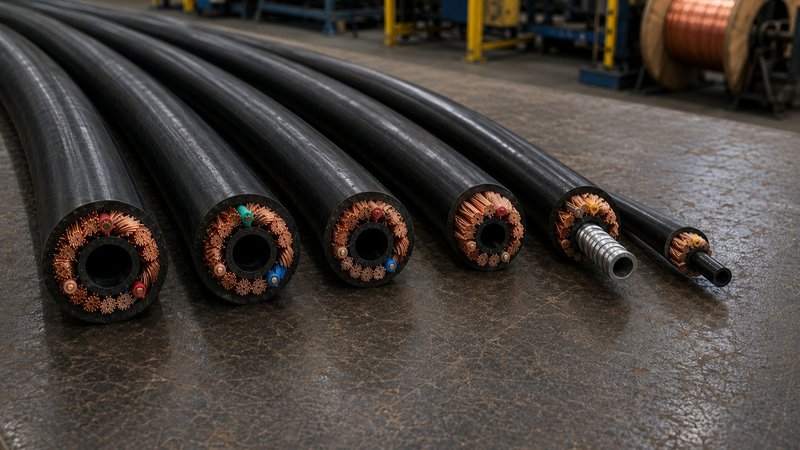
Handling separates them too. A MIG cable moves with the welder all shift. It needs fine stranding and a tough, flexible jacket. A grounding cable stays mostly in place. It still needs solid conductors and strong abrasion resistance. High duty cycles expose any weakness in either cable. Their failure modes differ as well. A MIG cable often fails at the flex points first. A grounding cable tends to fail at the clamp or connector. Matching each cable to its role reduces downtime. Smart cable construction keeps a whole welding fleet consistent.
Where Wire Feed Fits in the Bigger Picture
Wire feed lives on the MIG side of the circuit. The grounding cable plays no part in it. Steady feed depends on more than the cable, however. The liner, contact tip, and drive rolls all shape the result. These parts wear a little with every shift. Worn parts cause stutter, burnback, and erratic arcs. Operators usually feel these problems before they see them. A quick check of the liner and tip catches most issues early. Catching wear early keeps the whole line moving.
This is where feed components and consumables earn their keep. They are small parts with a large impact. Fresh liners and tips protect the entire weld. A simple replacement schedule prevents most feed problems. Quality consumables also let a good cable perform as designed.
Let Us Match Your Cables and Feed Components
You know your welding process better than anyone. We help you match the right cable to each job. At Electron Beam Technologies, we build custom MIG and grounding cables to your exact specs. We draw our own copper in-house. We mix and cure our own compounds on-site. Our electron beam process strengthens every jacket without harsh chemical accelerants.
Our accessory products line covers the feed components your team relies on. Think the tips, liners, and small parts that wear out first. Everything ships from the USA with short lead times. You skip the import delays and tariff exposure that come with overseas parts. Reach out today and we will build a solution around your bench.
You must be logged in to post a comment.